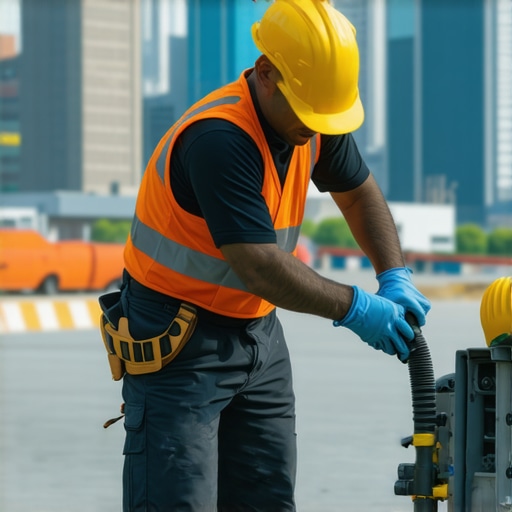
The Sound of Subsurface Survival
I can tell you the exact moment a job site turns from a controlled operation into a catastrophe just by the sound of the air. When you are standing in a narrow alley in a high-density urban corridor, surrounded by glass towers and the hum of a city that never sleeps, the sound is everything. My old journeyman used to say, ‘Water is lazy, but it’s patient.’ It will find the tiniest pinhole and turn it into a geyser given enough time. In the world of 2026 site services, that patience is our greatest enemy. We aren’t just digging holes anymore; we are performing surgery on the city’s veins. If you treat a vacuum nozzle with anything less than the respect you’d give a loaded shotgun, you’re asking for the soil to swallow you whole. High-density sites are a nightmare of utility congestion where a borehole is never just a hole—it’s a gamble against 19th-century iron and 21st-century fiber optics. To survive the next generation of urban infrastructure, we have to look at the physics of the suction and the chemistry of the slurry.
1. The Precision of Daylighting and Utility Verification
In the tight confines of a modern site, you don’t ‘dig’—you reveal. This is the heart of daylighting. The first rule for 2026 is that no mechanical bucket touches the ground until the utility ‘stack’ is visually confirmed. I’ve seen what happens when a backhoe tooth catches a high-pressure gas line; the sound of the hiss is something that stays in your marrow. By using daylighting, we use kinetic energy—either high-velocity air or pressurized water—to break apart the soil matrix without the ‘shear’ force that snaps copper lines like dry twigs. We are talking about vacuum excavation as a diagnostic tool. Before you even think about the rough-in for a new building’s sewer, you have to find where the old clay tile lateral is buried under three layers of asphalt and a century of ‘handyman’ hacks. If you don’t see the pipe with your own eyes, it doesn’t exist in your safety plan.
“All underground utilities shall be located and identified before excavation begins.” – ASTM D422-63(2007)e2 Standard Test Method
2. Managing the Kinetic Force of the Nozzle
Rule two is about the physics of the air lance. Many operators think more pressure equals more speed. That is a lie that gets pipes broken. When we are dealing with vacuum excavation, the goal is to create a localized pressure differential that ‘pops’ the soil loose. If you crank the PSI too high, you aren’t excavating; you are sandblasting. I have seen 4000 PSI water jets cut right through a PVC conduit like it was butter, leaving the wires inside exposed and sparking. You have to understand ‘differential pressure.’ In 2026 high-density sites, we use oscillating nozzles that spread the force. You want to see the soil crumble into the vacuum hose, not watch it explode in a cloud of dust that coats the neighboring skyscraper. This is where site services become an art form. You have to listen for the change in pitch—when the suction hit a solid object like a concrete thrust block or a buried cleanout, the sound goes from a hollow roar to a high-pitched whistle. That’s your signal to back off.
3. The Unholy Trinity of Slurry Management
On a high-density site, there is no ‘somewhere else’ to put the mess. The third rule is strict slurry containment. When you’re pulling up hundreds of cubic feet of grey, sulfur-smelling muck, you have to have a plan for where that ‘soup’ goes. In urban environments, the soil is often contaminated with decades of ‘dope’—pipe thread sealant—and old lead from retired water lines. You cannot just dump this into the gutter. Proper site services require a closed-loop system. We are talking about high-capacity debris tanks and decanting systems that separate the solids from the liquids. If your vacuum excavation rig is leaking a trail of black sludge across a city street, you’re going to be shut down before lunch. The slurry is heavy, too. A full tank of wet clay can shift the center of gravity on a truck, making it a tipping hazard in tight alleyways. Respect the weight of the waste.
4. Structural Stability and Soil Arching
High-density sites usually mean you are working inches away from existing foundations. Rule four: never underestimate soil arching. When you suck the dirt out from a deep borehole, you are removing the lateral support for the soil around it. In 2026, we use ‘trenchless-first’ mentalities, but when we have to go deep, we monitor the ‘heave.’ I once saw a sidewalk crack and drop four inches because a crew got too aggressive with their vacuuming near a building’s stack. They literally sucked the ‘fines’—the small particles—out from under the footer. You must use advanced site services to ensure that the vacuum isn’t creating a void larger than the hole you see at the surface. This is ‘forensic digging.’ You have to watch the ‘face’ of the excavation for signs of sloughing. If the soil looks like it’s bleeding water, you’ve hit a perched water table, and the physics of the hole just changed from ‘safe’ to ‘unstable.’
“The walls and faces of all excavations in which employees are exposed to danger from moving ground shall be guarded by a shoring system, sloping of the ground, or some other equivalent means.” – IPC Section 1101.4 (Referencing OSHA 1926.652)
5. The Integration of Borehole Technology
Rule five focuses on the synergy between the vacuum and the drill. In 2026, borehole strategies have evolved. We don’t just drill blind. We use innovative daylighting integration to clear the first ten feet of any vertical shaft. This ‘potholing’ technique ensures that the drill head doesn’t chew through a fiber optic backbone or a stub-out for a future utility connection. I’ve seen drill rigs lose their ‘mud’—the drilling fluid—into a void created by an old, abandoned sewer pipe. If you don’t use vacuum excavation to ‘pre-clear’ your borehole path, you are playing Russian roulette with the city’s infrastructure. It’s about optimizing borehole strategies to make sure every foot of depth is accounted for. You need to know if you’re hitting ‘fill’—trash, old bricks, and debris—or ‘virgin soil.’ The vacuum tells you the truth that the drill map hides.
6. Atmospheric Monitoring in the ‘Hot Zone’
The final rule is the one that saves lives: atmospheric testing. High-density sites often sit on top of old industrial land. When you break the surface of a deep trench, you aren’t just moving dirt; you are releasing trapped gases. Methane, hydrogen sulfide from a leaking Fernco fitting on an old sewer, or even gasoline vapors from a forgotten tank. You are standing in a ‘Hot Zone.’ Your vacuum rig is a giant air-mover, which is good for ventilation, but it can also pull concentrated gas pockets right toward the engine’s intake or the operator’s face. If you smell ‘rotten eggs,’ it’s already too late to start thinking about a monitor. You need real-time sensors at the pipe-face and at the debris tank. In the world of site services, what you can’t see is what kills you. If you want to keep your crew safe, you treat every hole like a confined space, even if they never step foot inside it. If you have questions about your specific site’s safety, you can always contact us for a forensic consultation. Buy the best equipment once, and you won’t have to cry over a site disaster later. Water is patient, and the earth is heavy. Don’t let them win.