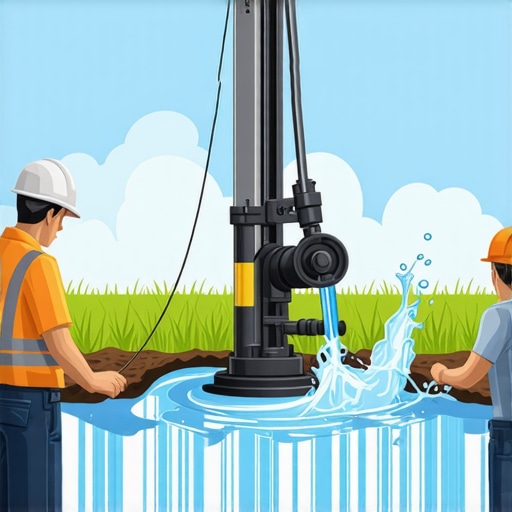
The Ghost in the Faucet: Why Your Yield is Dying
You turn the handle and instead of a steady, rhythmic flow of water, you get a violent, sputtering cough of air and brownish grit. That is the sound of a failing borehole. As a forensic piping consultant, I have spent decades dissecting these subterranean failures. My old journeyman used to say, ‘Water is lazy, but it’s patient.’ It will find the tiniest pinhole and turn it into a geyser given enough time, but it will also abandon a poorly constructed borehole the moment the physics of the well stop making sense. If you are looking toward 2026 and your water yield is already dropping, you are likely a victim of one of five technical sins committed during the rough-in stage of your well. We are going to zoom in on why these failures happen, from the chemistry of the grout to the mechanical friction of the drill string.
Blunder 1: The Vitrified Wall – When Heat Kills Hydrology
The first mistake happens at the bit. When a driller pushes too hard or uses the wrong RPM for a clay-heavy strata, they are not just making a hole; they are making a pot. The friction generates enough heat to ‘smear’ the clay along the borehole wall, creating a vitrified, ceramic-like glaze. This glaze acts as a waterproof seal, blocking the very water you are trying to extract. We call this ‘skin effect.’ In forensic analysis, I have seen boreholes where the aquifer is booming just six inches away, but the well is bone dry because the driller ‘baked’ the wall. To avoid this, sophisticated operators utilize optimizing borehole strategies to enhance service reliability by monitoring the slurry viscosity and bit temperature. If you do not clear that ‘cake,’ your 2026 yield will be non-existent.
Blunder 2: The Annular Space Grouting Disaster
Grout is not just filler; it is the structural and biological seal of your water supply. A common blunder is ‘bridging,’ where the grout gets stuck halfway down the hole, leaving a massive void in the annular space. This void is a highway for surface contaminants. I have waded through pump rooms where the water smelled like a sulfur pit because surface runoff was bypass-seeping into the well through a failed grout seal.
“The water-service pipe shall be separated from the building sewer by not less than 5 feet of undisturbed or compacted earth.” – IPC Section 603.2
When the annular seal fails, you are essentially drinking whatever is on the surface. Furthermore, if the grout is not chemically compatible with the groundwater, it will crack and shrink. Using vacuum excavation to verify the top-out of the seal is the only way to ensure that the borehole is actually isolated from the ‘black sludge’ of the upper soil layers.
Blunder 3: Utility Striking and the ‘Blind Drill’
Nothing ruins a water yield project faster than hitting a buried fiber optic line or a high-pressure gas main. It is the ultimate hack move. Handymen and ‘fast’ drillers think they know where the lines are, but they do not. This is why site services must include daylighting. Daylighting is the process of using air or water to safely expose underground utilities before the heavy iron moves in. I have seen projects shut down for months because a drill bit chewed through a telecommunications trunk, leading to lawsuits that out-cost the well itself. Safe site prep is not an option; it is a requirement for anyone who values their license and their budget. Utilizing advanced site services in excavation prevents the mechanical trauma that occurs when you drill ‘blind.’
Blunder 4: Improper Screen Sizing and Galvanic Corrosion
In the world of forensic piping, the well screen is where the battle is won or lost. If the slot size is too large, the well fills with ‘fines’—tiny sand particles that act like sandpaper on your pump’s impellers. Within a year, your pump is screaming and your yield is down 40%. Conversely, if the slots are too small, they scale up with calcium carbonate. If you mix a stainless steel screen with a galvanized riser, you have just built a battery. The resulting galvanic corrosion eats the metal, leaving a brittle, crumbly mess that eventually collapses.
“Thermoplastic Casing and Coupling Pipe shall be manufactured from materials meeting the requirements of ASTM D1784.” – ASTM F480
Selecting the right material is vital. If your driller did not test the water chemistry first to check the pH and TDS (Total Dissolved Solids), they were just guessing. Guesswork is why wells fail.
Blunder 5: Neglecting Borehole Development
A hole in the ground is not a well. A well is a developed hydraulic feature. Many drillers punch the hole, drop the casing, and leave. This leaves the ‘drilling mud’ lodged in the aquifer’s pores. You need to ‘surge’ the well, using air or mechanical plungers to push and pull water through the screen. This clears out the fines and creates a natural filter pack of gravel around the pipe. If you skip this, your 2026 yield will be choked by the very mud used to drill the hole. Modern borehole drilling techniques emphasize that development time is just as important as drilling time. If they did not spend hours surging and pumping the well until it was crystal clear, they did not finish the job. You will be left with a ‘lazy’ well that cannot keep up with demand.
Final Verdict: Buy It Once, Cry Once
Plumbing and borehole drilling are brutal realities where physics does not care about your feelings or your budget. If you cut corners on vacuum excavation or ignore the importance of site services, you are essentially throwing money into a dry hole. Water is patient, and it will eventually find a way to bypass your bad work or scale up your poorly sized screens. Do the job right the first time. Hire pros who understand site services and the chemistry of the earth. Otherwise, in 2026, when your neighbors are enjoying high-pressure showers, you will be staring at a dry tap and a massive repair bill. Respect the pipe, respect the earth, and never trust a ‘flushable’ wipe or a ‘cheap’ driller. “