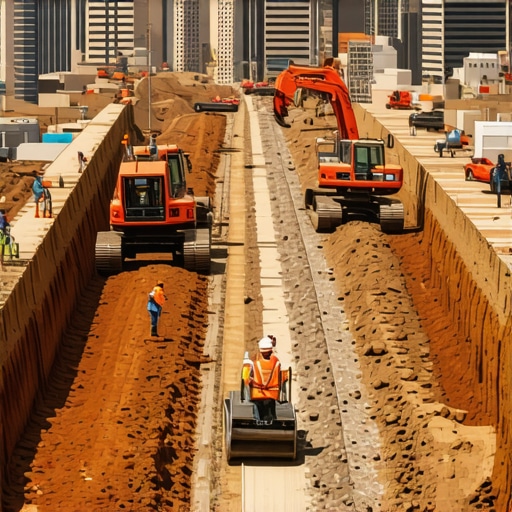
The Invisible Labyrinth Beneath the Asphalt
My old journeyman used to say, ‘Water is lazy, but it’s patient.’ It will find the tiniest pinhole and turn it into a geyser given enough time. But when we’re talking about high-density urban sites in 2026, the patience isn’t just in the water—it’s in the physics of the soil. When you’re standing in a trench in the middle of a downtown core, you aren’t just looking at dirt. You’re looking at a compressed timeline of human error and civil engineering, a spaghetti-mess of fiber optics, high-voltage lines, and old cast-iron sewer stacks that are one wrong bucket-tooth away from a city-wide blackout or a localized flood. This is why vacuum excavation isn’t just a luxury; it’s the only way to survive the subterranean chaos of modern site services. Traditional digging is a blunt instrument in a world that requires a scalpel.
“Trenching and excavation work is hazardous to all workers involved. Cave-ins pose the greatest risk and are much more likely than other excavation-related incidents to result in worker fatalities.” – OSHA Standard 1926 Subpart P
1. Precision Daylighting and the ‘Surgical’ Air Knife
The first tactic for 2026 is moving beyond the standard water-pressure wand to advanced air-knife systems for daylighting. When you’re working in a high-density zone, you can’t afford the slurry mess of hydro-excavation every single time. Air knives allow you to pulverize the soil—turning compacted clay into a dry dust that the vacuum truck sucks up instantly—without the risk of cutting through the ‘yellow jacket’ coating of a gas main. I’ve seen backhoes rip the coating off a pipe, leaving it to corrode in the acidic urban soil until it fails three years later. By using air-based vacuum excavation, you’re maintaining the integrity of the utility’s cathodic protection. It’s about more than just finding the pipe; it’s about leaving it in the same condition you found it. This level of precision is why many contractors are choosing the right site services that prioritize non-destructive methods.
2. The Borehole Stabilization Protocol
In the urban ‘Hydro-Geography’ of a city like Chicago or Toronto, frost depth is your mortal enemy. When you sink a borehole for a new utility pole or a structural support, the surrounding soil is often a mix of fill, gravel, and ancient organic matter. If you use a traditional auger, you’re vibrating the hell out of the surrounding earth, potentially causing a collapse or shifting a nearby water main. The 2026 tactic involves using vacuum pressure to clear the hole while simultaneously lining it with a temporary sleeve. This prevents ‘necking’—where the soil squeezes the hole shut before you can pour your grout or set your pipe. For those looking for technical specifics, mastering borehole drilling techniques is essential for ensuring that the structural ‘Rough-in’ doesn’t fail before the project even starts.
3. Managing Subsurface Complexity with Real-Time Mapping
In high-density sites, the maps are almost always wrong. I’ve ‘Top-out’ on projects where the blueprints showed a clear path, only to find a 1920s-era brick sewer that was never decommissioned. The tactic for the future is integrating vacuum trenching with ground-penetrating radar (GPR). You vacuum a pilot hole—a ‘Stub-out’ for information—and use sensors to see what’s five feet ahead. This is the ultimate vacuum excavation for accurate subsurface assessments. It’s about reducing the ‘Ohmic’ resistance of the project—making sure the work flows without hitting the high-voltage resistance of an unmarked line. If you ignore this, you’re not just a plumber or a tech; you’re a liability waiting to happen.
“Horizontal directional drilling (HDD) shall not be used unless the existing utility locations are determined by potholing or other methods of positive identification.” – ASTM F1962 – 11
4. Slot Trenching for Minimal Surface Disruption
Why dig a four-foot-wide grave for a two-inch conduit? In 2026, the ‘Slot Trench’ is king. Using a narrow vacuum nozzle, you can cut a trench only six inches wide. This is vital when you’re working under a sidewalk or near a historic building’s foundation. You avoid the ‘bulk excavation’ nightmare where you have to replace three slabs of concrete because you cracked one. By keeping the trench narrow, you preserve the ‘bridge’ of the soil, maintaining the natural compaction. This is how vacuum excavation reduces site disruption, keeping the city moving while you’re doing the ‘Dope’ work underground. It’s efficient, clean, and prevents the ‘black mush’ of oversaturated soil from undermining the neighboring structures.
5. Integrating Sustainable Site Services
Finally, we have to talk about the ‘bio-load’ of construction. High-density sites have zero room for waste. The old way was to dump the spoils into a pile and haul them away later. The 2026 tactic is closed-loop vacuum systems that separate the liquids from the solids on-site, allowing the water to be recycled for the hydro-excavation head and the dry dirt to be used as backfill. This isn’t just ‘green’ nonsense; it’s logistics. If you don’t have to wait for a dump truck to fight through city traffic, you’re saving thousands in ‘Rough-in’ time. Understanding how site services drive efficiency is the difference between a profitable job and one that gets buried in overhead costs. Water is lazy, but as a forensic plumber, I know that laziness in the planning stage leads to a ‘Fernco’ fix on a ‘Stack’ that should have been replaced right the first time. Buy it once, cry once—dig it right, or don’t dig it at all. { “@context”: “https://schema.org”, “@type”: “HowTo”, “name”: “Vacuum Trenching for Urban Sites”, “step”: [ { “@type”: “HowToStep”, “text”: “Conduct GPR sweep to identify potential utility conflicts.” }, { “@type”: “HowToStep”, “text”: “Use air-knife vacuum excavation for precision daylighting of sensitive lines.” }, { “@type”: “HowToStep”, “text”: “Implement slot trenching to minimize surface restoration costs.” } ] }