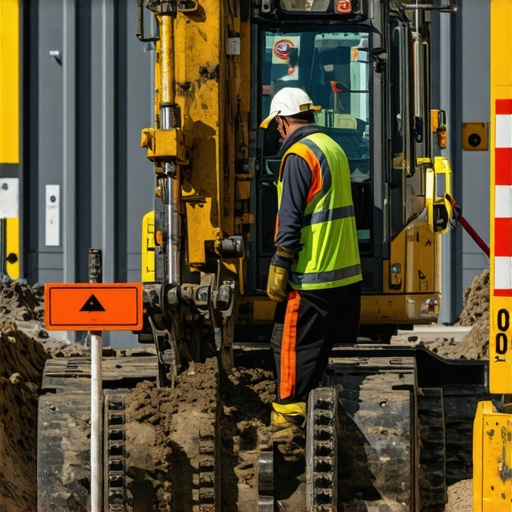
The Autopsy of a Shovel Strike: Why the Ground is a Minefield
My old journeyman used to say, ‘The ground is a graveyard of things people forgot they buried.’ He wasn’t talking about time capsules or treasure; he was talking about the 2-inch high-pressure gas line that some cowboy laid in 1974 without a tracer wire. I remember a job in the dead of a Chicago winter where the frost had driven six feet deep into the clay. We were looking for a cleanout on a main stack that had backed up into a commercial kitchen. The owner didn’t want to pay for a locator. He handed a laborer a spade and told him to find the pipe. One hour later, the clink of steel hitting cast iron wasn’t a sound of success—it was the sound of a legacy water main shattering like glass because the frozen earth offered zero give. That single shovel thrust caused a hydrostatic shock that sent a pressure wave back to the stub-out, blowing the wax ring off a toilet three blocks away. This is the reality of hand digging in an era where the subsurface is more crowded than a rush-hour subway.
The Physics of the North: Why Frozen Earth Changes the Game
When you are working in northern climates like Chicago or Toronto, you aren’t just fighting dirt; you are fighting the phase-change of water. In 2026, the density of underground infrastructure—fiber optics, electrical grids, and aging pressurized mains—means that the ‘feel’ of a shovel is no longer a safety measure. Ice expands by approximately 9%, and in tightly packed soil, that expansion creates a pre-stressed environment. When you introduce the blunt force of a hand tool, you are essentially hitting a loaded spring. The soil is so rigid that the force of the strike is transferred directly into the utility. This is where vacuum excavation becomes the only logical choice. Instead of a hard edge, you use a kinetic stream of air or water to emulsify the soil. This prevents the catastrophic shearing of copper lines that have become brittle from decades of pitting and graphitization.
“Trenching shall be excavated to a depth that permits the installation of the pipe on a firm, continuous and uniform bearing of undisturbed soil.” – IPC Section 306.3
The Hidden Enemy: Decaying Subsurface Integrity
Over 30 years, I’ve seen what happens when a spade tip meets a 1950s-era ductile iron pipe. The exterior might look solid, but inside, calcification and tuberculation have turned the pipe wall into a thin, crunchy wafer. A hand-dug trench puts uneven pressure on these ‘zombie pipes.’ You think you’re being careful, but as you remove the supporting soil, the pipe sags. That’s when the Fernco coupling you installed last year fails, or the dope on the threaded joints cracks. By 2026, the sheer age of our utility grid makes hand digging a liability nightmare. Using advanced site services is about more than just speed; it’s about forensic-level preservation of what’s already down there. When you utilize daylighting benefits, you are literally bringing the pipe into the light without ever touching it with a metallic tool.
The 2026 Mandate: Precision Over Perspiration
Why is the industry moving away from the shovel? Because a fiber-optic strike can cost a contractor $50,000 per hour in downtime and liquidated damages. When you are performing a rough-in for a major utility project, you are dealing with a ‘utility soup.’ In the past, we relied on ‘as-built’ drawings, but as any forensic plumber knows, as-builts are often lies. Pipes shift due to frost heave and soil subsidence. The only way to verify a borehole path safely is through non-destructive methods. Borehole drilling techniques now often require a pre-cleared path. If you try to hand-dig that clearance in 2026, you’re risking a strike on a ‘ghost line’—a utility that was never recorded but is very much live and dangerous.
“The pipe shall be bedded in accordance with the manufacturer’s installation instructions to ensure structural integrity.” – UPC Section 314.4
Vacuum Excavation: The Forensic Plumber’s Scalpel
If you’ve ever smelled the copper-sulfate tang of a broken water line or the rotten-egg stench of a gas leak, you know why I hate hand digging. It’s an imprecise tool for a precise world. Vacuum excavation uses high-CFM (cubic feet per minute) suction to remove the ‘slurry’ created by the hydro-jet. It allows us to see the exact condition of the pipe—the corrosion, the leaking joints, and the shifting bedding—without the risk of making the problem worse. This level of reducing site disruption is essential for 2026 projects where urban density leaves no room for error. We aren’t just moving dirt anymore; we are performing surgery on the city’s veins.