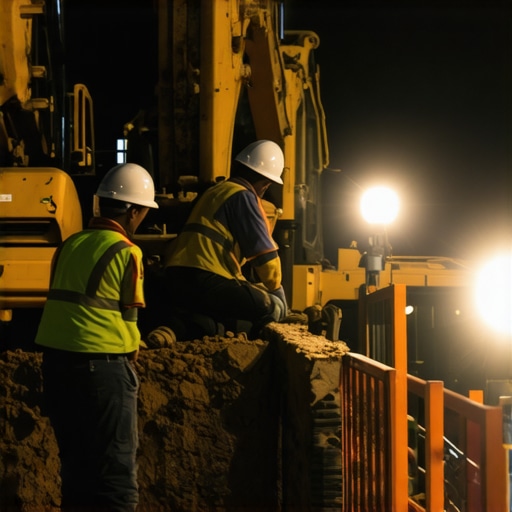
The Autopsy of a ‘Blind’ Strike
The sound of a backhoe tooth catching a two-inch Type L copper main isn’t just a mechanical failure; it’s a high-pitched metallic ‘ping’ followed by a roar that sounds like a jet engine taking off in a muddy trench. I’ve stood in those trenches, the cold, gritty slurry filling my boots while the site foreman screams into a radio. When you dig blind, you aren’t just moving dirt; you’re playing Russian Roulette with the physical infrastructure of a city. My old journeyman used to say, ‘Water is lazy, but it’s patient.’ It will find the tiniest pinhole and turn it into a geyser given enough time, and when you nick a pipe with a five-ton machine, you’ve just fast-forwarded that patience into a catastrophe. In the South, especially where the heavy clay soil shifts and swells like a slow-motion ocean, these buried lines are under constant stress. A copper pipe encased in concrete or buried in expansive clay is already fighting stress corrosion cracking; one wrong move with a bucket and you’ve triggered a structural failure that can’t be fixed with a quick Fernco and a prayer.
“Piping shall be installed so as to prevent the required strength of the building from being reduced. The installation shall not cause damage to structures or to the property of others.” – IPC Section 307.1
Tactic 1: Vacuum Excavation – The Surgical Strike
If you’re still using a shovel and a hope for your rough-in inspections, you’re living in the dark ages. The first tactic for 2026 safety is the total abandonment of mechanical digging near known utility corridors. This is where vacuum excavation comes in. It’s the difference between a butcher’s cleaver and a surgeon’s scalpel. By using pressurized air or water to pulverize the soil, you turn a solid mass into a fluidized soup that the vacuum nozzle inhales with a rhythmic, wet thumping sound. This process, often called vacuum excavation, exposes the pipe without the risk of shearing a fitting or stripping the protective coating off a gas line. I’ve seen top-out crews save thousands of dollars just by seeing exactly where the stack meets the lateral before they ever drop a bucket into the ground.
Tactic 2: The Borehole Analytical Protocol
Before you even think about your stub-out locations, you need a map of what’s beneath the surface. We aren’t just talking about a ‘Call Before You Dig’ flag. Real pros are optimizing borehole strategies to understand the soil density and moisture content. In the Texas clay, if you hit a pocket of anaerobic soil near a buried iron line, you’re looking at a pipe that’s likely paper-thin from galvanic corrosion. A borehole gives you a core sample of the enemy. It tells you if the soil is going to collapse the moment you break the surface tension, or if you’re dealing with a rock shelf that’s going to deflect your drill head into a 13kV power line. This is the forensic side of plumbing—predicting the failure before it manifests as a muddy lake in the middle of a job site.
Tactic 3: Strategic Daylighting for Subsurface Integrity
Daylighting is the process of exposing the utility to the sun, and it’s the only way to be 100% sure of your depth. I’ve seen cleanouts that were marked on the blueprints as four feet deep actually sitting at eighteen inches because some previous handyman ‘hacked’ the grade. When you utilize daylighting benefits for sustainable urban infrastructure, you are performing a visual audit of the site’s health. You can see the white calcification on a joint that’s about to give up the ghost, or the way a wax ring failure from a decade ago has turned the surrounding soil into a black, sulfurous mush. You can’t see that through a radar screen. You have to get eyes on the pipe. You have to see the dope on the threads to know if that gas line was put together by a pro or a pretender.
“Excavation shall be made by such methods as will not be liable to cause damage to the public main or to the property of others.” – UPC Section 314.1
Tactic 4: Integrated Site Service Coordination
The final tactic is the coordination of maximizing safety with advanced site services. This means the plumber, the excavator, and the utility locator are all reading the same sheet music. I once waded into a basement in a South Florida high-rise where the slab had been breached because the excavator didn’t realize the hydro-static pressure in the area. Water started geysering up through the floor like a ruptured artery. It turned the entire site into a swamp in twenty minutes. If they had integrated their site services, they would have known the water table was sitting just six inches below the slab. Instead, they dug blind and paid the price in structural remediation. In 2026, we don’t have the margin for error. We use the tech, we respect the physics, and we remember that ‘buy it once, cry once’ applies to your excavation methods just as much as it does to your fixtures. Don’t be the guy who finds the utility with a bucket tooth. Use the vacuum, use the boreholes, and keep your site out of the ‘accidental disaster’ files.