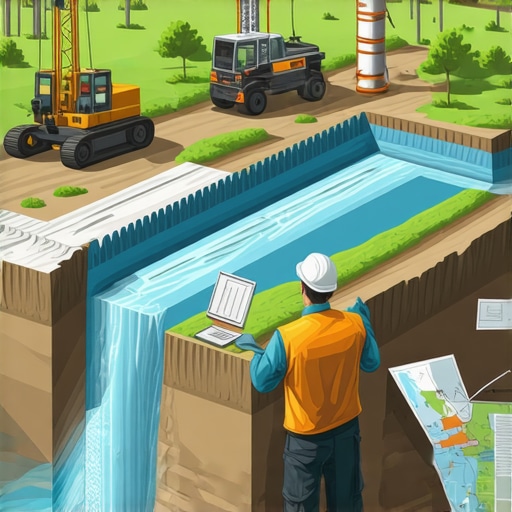
The Anatomy of a Dry Hole: Why Water is a Patient Predator
My old journeyman used to say, ‘Water is lazy, but it’s patient.’ It will find the tiniest pinhole in a copper line and turn it into a basement-destroying geyser given enough time, yet when you actually go looking for it in the earth, it hides behind layers of stubborn clay and calcified rock like a fugitive. In thirty years of forensic plumbing and site work, I have seen more money wasted on blind drilling than on bad pipe dope and cracked wax rings combined. By 2026, the game changes. Shifts in local water tables and increasing urban density mean that finding a high-flow aquifer isn’t just about pointing a stick at the ground; it’s about reading the subsurface like a crime scene. When a borehole fails to hit the promised gallons per minute, it’s usually because the driller ignored the chemistry of the strata or the mechanical interference of nearby infrastructure. You can smell a successful site before you even rig up—the damp, metallic scent of cold earth being pushed to the surface. If you smell nothing but dry dust, you’re just making an expensive grave for a PVC casing.
“The annular space between the casing and the wall of the borehole shall be effectively sealed to prevent surface water or shallow groundwater from contaminating the aquifer.” – ASTM D5092/D5092M-16
The Science of Subsurface Forensic Analysis
To find water that actually flows, you have to understand hydraulic conductivity. It’s not just about a wet spot in the dirt. It’s about the pore spaces between the grains of sand or the fractures in the bedrock. In many 2026 projects, we are dealing with ‘perched’ water tables—pockets of moisture trapped above an impermeable layer of clay. A novice driller hits this, sees a splash, and thinks they’ve struck gold. But two weeks later, the well is dry because that pocket had no recharge. This is where hydraulic zooming becomes critical. We look at the cation exchange capacity of the surrounding soil. High-clay environments often suffer from deflocculation, where the fine particles swell and choke off the water’s path to your screen. This leaves you with a ‘tight’ formation that won’t yield, no matter how much you surge the well. This is why optimizing borehole strategies to enhance service reliability is the difference between a productive asset and a plastic straw in a dry glass. We look for the ‘crunch’—that specific vibration in the drill string that signals a transition from silty overburden to clean, water-bearing gravel.
The Role of Vacuum Excavation in Aquifer Identification
Before you ever set a bit, you have to clear the ‘hot’ zone. Modern 2026 site services require more than a map and a prayer. We use vacuum excavation to perform what we call ‘daylighting.’ This isn’t just about safety; it’s about forensic geological mapping. By using high-pressure water or air to liquefy the soil and sucking it into a debris tank, we can actually see the first three to ten feet of the formation without grinding it into an unrecognizable slurry. This process, often called exploring daylighting benefits for sustainable urban infrastructure, allows us to inspect for utility interference and the initial moisture markers that indicate the deeper hydrostatic head. When you’re choosing site services for safe site prep, you are essentially buying a window into the earth. It prevents the ‘hack job’ of accidentally shearing a 4-inch sewer main while hunting for a water source. I’ve seen what happens when a mechanical auger hits a pressurized gas line; it doesn’t just stop the project, it levels the block. Vacuum excavation is the only way to ensure the rough-in phase of your borehole doesn’t become a disaster recovery operation.
“Groundwater shall be assumed to be present at any time at any site, unless specifically proven otherwise by geotechnical investigation.” – IBC Section 1803.5.4
Hard Water Chemistry and Borehole Longevity
If your project is in an area with high mineral content, you aren’t just fighting physics; you’re fighting chemistry. Hard water is a slow-motion clog. Calcium and magnesium carbonates will precipitate out of the water as soon as the pressure drops near the well screen, creating a rock-hard scale that seals the pipe from the outside in. This is calcification at its worst. In my decades of ‘sweating’ joints and pulling old stacks, I’ve seen 4-inch pipes reduced to the diameter of a pencil by this black, crusty sludge. For 2026 borehole projects, we must analyze the pH and the Langelier Saturation Index (LSI). If the water is too aggressive (acidic), it will eat through a galvanized casing in five years, leading to a catastrophic collapse of the borehole walls. If it’s too scaling, it will choke your flow. Utilizing borehole drilling techniques that allow for chemical surging and proper screen placement is vital. You have to treat the borehole like a living organism. If you don’t provide a way for it to breathe (proper venting and cleanouts), it will eventually suffocate under its own mineral weight. We use bentonite slurries carefully; too much, and you seal the aquifer you’re trying to tap. It’s a delicate balance of hydrostatic pressure and mechanical integrity.
Site Services: Integrating Daylighting and Borehole Logistics
The logistics of a high-flow project in 2026 demand a ‘Top-out’ mentality. You don’t just drill; you manage the entire site ecosystem. This includes choosing the right site services to handle the massive amounts of spoils and water generated during the development phase. When you hit a high-flow table, you might be dealing with hundreds of gallons per minute surging up the annular space. If you haven’t planned for dewatering, your site becomes a swamp, and your borehole becomes a geyser that undermines the foundations of nearby structures. We use Fernco-style couplings and heavy-duty stub-outs to manage discharge. Proper borehole installation tips emphasize the use of a proper well seal and a sanitary cap. Water always wins, but with the right forensic approach, we can at least decide which direction it flows. Respect the biology of the earth and the physics of the pressure, and you’ll find the flow every time. If you ignore them, you’re just another handyman with a broken tool and a wet pair of boots.