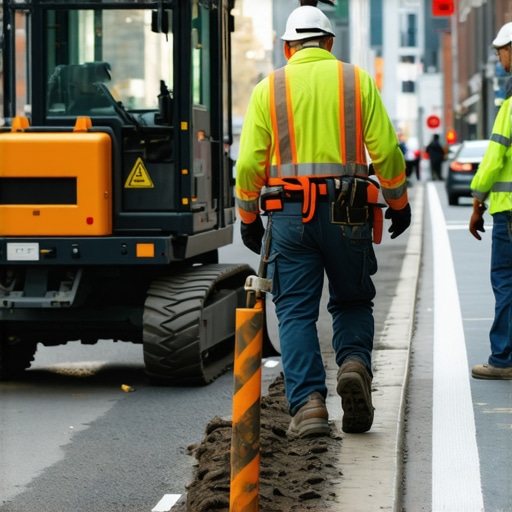
The Expensive Snap: When Backhoes Meet Fiber
There is a specific sound you never forget once you’ve heard it in the field. It isn’t the loud clang of metal on metal; it’s a sickening, high-tension snap followed by the absolute silence of a neighborhood losing its connection to the world. In my thirty years of crawling through the muck and auditing failed infrastructure, I’ve seen more 5G conduits shredded by ‘blind digging’ than I care to count. We are moving into an era where the data flowing under our feet is as vital as the water in our mains, and the old ways of rough-in excavation are dead. If you are still using a mechanical tooth to find a 5G line in 2026, you aren’t just a plumber or a contractor; you’re a liability. My old journeyman used to say, ‘Water is lazy, but it’s patient.’ It will find the tiniest pinhole and turn it into a geyser given enough time. The same logic applies to the earth around our utilities. The soil is patient, shifting and compacting until it hides the very cables we spent millions to bury. Using vacuum excavation is no longer an ‘option’ for high-stakes site services; it is the only way to ensure we don’t turn a routine borehole into a catastrophic outage. In the frozen reaches of the North, where frost depth can reach five feet, the ground becomes a literal block of concrete. Mechanical digging in these conditions is like trying to perform surgery with a sledgehammer. The ice expands by 9%, locking the cables in a frigid vice. When a backhoe bucket hits that frozen mass, the energy transfer doesn’t just stop at the bucket; it ripples through the frozen soil, snapping fiber optics twenty feet away from the actual dig site.
“Excavation and backfill for piping shall be in accordance with the International Plumbing Code. Trenches shall be excavated to a depth that provides a uniform and continuous bearing and support for the pipe.” – IPC Section 306.2
Rule 1: The Pressure Threshold and Hydro-Mutilation
One of the biggest mistakes ‘green’ operators make is assuming that more pressure equals faster work. In 2026, the 5G fiber jackets are thinner and more sensitive to thermal fluctuations. If you’re using hydro-excavation at 4,000 PSI, you aren’t digging; you’re water-jet cutting. I’ve seen high-pressure streams strip the protective coating off a conduit in seconds, leaving the glass fibers exposed to the grit and minerals of the soil. This leads to what I call ‘hydro-mutilation.’ You must calibrate your vacuum excavation equipment to the specific soil density. In clay-heavy regions like the Midwest, the suction must be steady, pulling the slurry out without creating a vacuum lock that could collapse the very borehole you are trying to clear. We use a ‘Dope’ check on all fittings before the vacuum starts to ensure no air leaks reduce the efficiency of the lift.
Rule 2: Master the Art of Daylighting
In the trade, we call it daylighting, and it’s the only way to truly verify what the utility maps claim is there. I’ve seen ‘as-built’ blueprints that were off by six feet. If you rely on a piece of paper, you’re going to hit something. Vacuum excavation allows for precise ‘potholing’ or daylighting, where you gently remove the overburden until the crown of the pipe or conduit is visible. This is critical for exploring daylighting benefits in urban environments where the ‘stack’ of utilities is a chaotic mess of old cast iron, lead, and new fiber. When you see that colorful plastic or the dull gray of the conduit, you stop. You don’t guess. You verify.
Rule 3: Soil Stability and the 45-Degree Slope
In the North, the freeze-thaw cycle is your worst enemy. When you dig a hole, you’re changing the thermodynamics of the surrounding earth. If you leave a vertical cut in sandy soil, it will slough off, potentially shearing the small-diameter 5G lines. Rule number three is maintaining the angle of repose. Even with vacuum-extracted holes, you need to be mindful of the ‘bell-mouth’ effect at the top of the hole. Proper site services demand that we stabilize the perimeter. I’ve seen ‘top-out’ crews lose a whole day because a borehole collapsed due to poor moisture control in the surrounding soil. This isn’t just about the pipe; it’s about the physics of the ground itself.
“The pipe shall be supported on a firm bed for its entire length. Where the trench is in rock, the pipe shall be bedded in at least 4 inches of sand or fine gravel.” – ASTM D2321 Standards
Rule 4: Slurry Management and the ‘Black Soup’
When you’re vacuuming, you’re creating a slurry—a thick, heavy ‘black soup’ of soil and water. If you don’t manage this correctly, you’re just moving the problem from the hole to the street. In 2026, environmental regulations are tighter than a new wax ring on a closet flange. You need a dedicated system for slurry containment. This is why choosing the right site services is a make-or-break decision for project managers. You need a crew that understands that ‘cleanout’ isn’t just a word for a sewer pipe; it’s the process of keeping the vacuum truck operational and the site compliant. If that slurry freezes in your tank in a Chicago winter, you’re dead in the water until spring.
Rule 5: Borehole Integrity and Precision Lining
Installing 5G fiber often requires horizontal directional drilling (HDD). The vacuum-excavated borehole acts as the ‘viewing window’ for the drill head. If your borehole isn’t clean, the driller is flying blind. Rule five is ensuring optimizing borehole strategies is part of your initial rough-in. You want to see the drill head pass through the daylighted area with at least six inches of clearance from existing utilities. Anything less is a gamble. I’ve seen drillers ‘nick’ a gas line because the vacuum crew didn’t clear enough space to see the true orientation of the pipe. It looked fine from the top, but the bottom of the pipe was encased in a ‘Fernco’ patch that made it wider than expected.
Rule 6: Mitigating Site Disruption
The final rule is about the footprint you leave behind. In 2026, 5G is being deployed in densely populated urban centers. You can’t just shut down three lanes of traffic to dig a trench. This is where the surgical precision of the vacuum comes in. By reducing site disruption, you’re not just saving money on traffic control; you’re preventing the secondary damage caused by heavy machinery vibrations. I’ve seen old galvanized water lines three houses down start ‘sweating’ and eventually burst just because a 20-ton excavator was pounding the pavement nearby. Vacuum excavation is a ‘top-out’ technology that respects the existing infrastructure. It is quiet, it is clean, and it is the only way to protect the delicate glass threads that carry our world’s data. Buy it once, cry once—invest in the right tech or pay the price when the 5G goes dark and the lawsuits start flying.