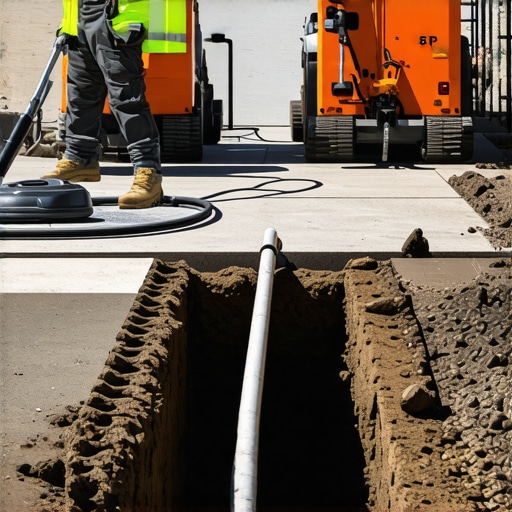
The Phantom Utility and the Physics of Failure
My old journeyman used to say, ‘Water is lazy, but it’s patient.’ It will find the tiniest pinhole and turn it into a geyser given enough time. But when you are standing on a job site with a backhoe idling behind you, the hidden utilities under your boots aren’t lazy—they are landmines. I have spent thirty years in the mud, and I have seen what happens when ‘close enough’ isn’t. You trust a Ground Penetrating Radar (GPR) scan like it is the word of God, and then you hear it: that sickening, metallic thrum of a bucket teeth catching a pressurized main. It is a sound that makes your stomach drop faster than a wax ring on a hot July day.
By 2026, the density of our subsurface infrastructure—the stacks of fiber optics, the gas lines, the cast-iron sewer mains—has reached a breaking point. Relying solely on GPR is like trying to diagnose a clogged stack through a brick wall. It gives you a guess, a fuzzy gray ghost on a screen, but it doesn’t give you the truth. To get the truth without a catastrophic failure, you need the surgical precision of vacuum excavation.
“Where pipes are installed through or under footings or foundation walls, such pipes shall be protected from damage by a relieving arch or a pipe sleeve.” – IPC Section 305.5
In regions with expansive clay soils, like Texas or Florida, GPR is notoriously unreliable. The soil’s high conductivity eats the radar signal, leaving you blind to the very utilities you are trying to protect. This is where the hydro-geographic reality sets in: clay shifts, it shears, and it hides the rot. If you are prepping a site for a new borehole or a complex rough-in, you cannot afford to gamble on a blurry image.
1. The Failure of the Signal: Why Clay Soil Kills GPR
Ground Penetrating Radar relies on electromagnetic pulses. In a perfect world—dry, sandy, uniform soil—it works beautifully. But we don’t live in a perfect world. We live in a world of high water tables and mineral-heavy earth. When those radar waves hit wet clay or salt-laden soil, they don’t bounce back; they dissipate. You end up with a ‘blind spot’ exactly where your stub-out needs to be. Vacuum excavation bypasses this physics hurdle entirely. Instead of guessing based on a signal, you are daylighting the utility. You are seeing the actual pipe, the color of the PVC, the rust on the ductile iron, and the state of the Fernco couplings. You are removing the ‘maybe’ from the equation.
2. The Danger of the ‘Ghost Line’ and Utility Strike Liability
I have performed enough forensic plumbing ‘autopsies’ to know that GPR often creates ‘ghost lines’—reflections from tree roots or large rocks that look identical to a 4-inch sewer line. If you dig based on a ghost, you miss the real line six inches to the left. The result? A geyser of black sludge or, worse, a hissing gas line. Vacuum excavation uses high-pressure air or water to liquefy the soil, which is then sucked away into a debris tank. This process is non-destructive. It won’t shear a wax ring or crack a brittle, aged stack. By utilizing advanced site services, you shift the risk from ‘high’ to ‘negligible.’
“Excavation and trenching shall be performed in accordance with the regulations of the authority having jurisdiction.” – UPC Section 314.1
3. Precision Daylighting for Borehole Integration
When you are setting up for borehole drilling, the tolerance for error is zero. You aren’t just digging a hole; you are performing surgery on the earth. A drill bit doesn’t care about a GPR scan; it only cares about what it hits. Using vacuum excavation for daylighting ensures that every borehole is placed with absolute certainty. You can see the configuration of the underground network, identifying where the old-timers used pipe dope on joints that are now leaking and saturating the surrounding soil. This saturated soil can further distort GPR signals, creating a feedback loop of misinformation that only a vacuum truck can break through.
4. Cost Efficiency in Urban Site Services
There is a myth that vacuum excavation is too expensive for routine work. That is ‘handyman logic.’ The cost of a vacuum truck for one day is a fraction of the cost of a utility strike, the OSHA fines, the emergency repairs, and the lost reputation. In 2026, site services must be lean and fast. Traditional excavation with a backhoe requires a wide swing radius and creates a massive mess. Vacuum excavation is surgical. You can dig a 12-inch wide hole straight down to a utility 10 feet deep without disturbing the surrounding pavement. It is the only way to handle a top-out in a dense urban environment where every square inch of dirt is packed with cables.
The Forensic Conclusion: Water Always Wins
At the end of the day, physics doesn’t care about your project deadline. Water will find the path of least resistance, and a backhoe bucket will find the pipe you didn’t see on the GPR. Whether you are dealing with the frost-heave of the north or the shifting slabs of the south, vacuum excavation is the only method that respects the reality of the subsurface. Don’t be the guy who trusts a fuzzy screen and ends up waist-deep in a basement flood. Buy it once, cry once—invest in the right site prep solutions and see what you are digging before the first spark flies. To learn more about how we can secure your next project, feel free to contact our team of experts today.