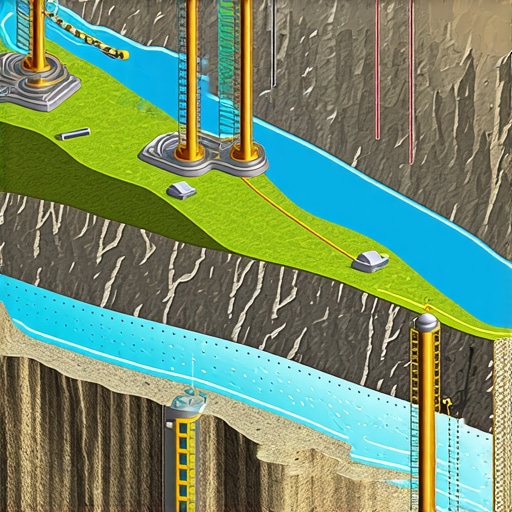
The Anatomy of Subsurface Failure
My old journeyman used to say, ‘Water is lazy, but it’s patient.’ It will find the tiniest pinhole and turn it into a geyser given enough time. In the world of commercial site services, that patience manifests as hydrostatic pressure screaming against a poorly seated borehole casing. When you are standing in a muddy trench at 4 AM because a subterranean vein decided to relocate, you realize that mapping an aquifer isn’t just geology—it’s forensic plumbing on a massive scale. We aren’t just punching holes; we are performing surgery on the earth’s vascular system.
“Boreholes shall be grouted for the full depth from the top of the pressure tank or well seal to the bottom of the casing.” – IPC Section 602.3.4
The failure of a borehole usually doesn’t start with a bang. It starts with a whisper of silt, a slight discoloration in the discharge, and eventually, the structural compromise of the surrounding strata. By 2026, the old ways of ‘poke and hope’ are dead. We are moving into an era of hydraulic precision where we treat every cubic yard of soil like a complex manifold. If you aren’t using vacuum excavation to verify your site services before the drill bit even touches the dirt, you are basically playing Russian roulette with a backhoe.
Tactic 1: Non-Destructive Daylighting as Forensic Truth
Before we commit to a deep-bore strategy, we must use daylighting. This isn’t just a buzzword; it’s the process of using pressurized water or air to liquefy the soil and a high-cfm vacuum to suck it away, exposing the ‘veins’ of the site—gas lines, fiber optics, and existing water mains—without the risk of a mechanical strike. Imagine trying to sweat a copper joint while someone is shaking the ladder; that is what it feels like to drill blind. Vacuum excavation provides the forensic clarity needed to ensure the borehole doesn’t intercept a legacy ‘stub-out’ or a forgotten cleanout. You can learn more about how vacuum excavation is a modern solution for this exact type of high-stakes site prep.
Tactic 2: Integrated Aquifer Pressure Profiling
Water quality in the deep strata is often a battle against chemistry. If the pH is off, or if you have high levels of dissolved CO2, you are looking at pitting corrosion in your steel casings within five years. In 2026, we are mapping these chemical profiles before the first rough-in. We look for signs of anaerobic bacteria that produce hydrogen sulfide—that rotten egg smell that indicates a dying well. We use borehole sensors to measure the draw-down rate in real-time. This prevents the ‘lazy water’ from finding a path through the grout and contaminating the upper-level water table. Properly optimizing borehole strategies ensures that the service reliability isn’t compromised by these chemical skirmishes.
“Vacuum excavation shall be used for uncovering underground facilities within the tolerance zone.” – ASTM F2301
Tactic 3: Strata-Specific Casing and Grout Dope
In the plumbing trade, we use pipe dope to seal threads. In the borehole world, our ‘dope’ is a sophisticated bentonite slurry mixed with polymers designed to resist the specific mineralogy of the site. If you are drilling through limestone, you need a different mix than if you are hitting Canadian Shield granite. This prevents ‘short-circuiting,’ where water from a contaminated upper aquifer leaches down the side of your pipe into the pristine lower aquifer. Using innovative borehole drilling techniques is the only way to ensure the hydraulic seal remains intact against the shifting pressures of the earth.
Tactic 4: Digital Twins of Site Services
The final tactic for 2026 is the integration of site services data into a live ‘Digital Twin.’ We are no longer relying on faded blue-prints or the ‘gut feeling’ of an operator. We map the stack of utilities and aquifers with LiDAR and Ground Penetrating Radar, then overlay that with our vacuum excavation findings. This creates a 3D map where every fernco-style coupling and wax ring-equivalent seal is documented. This level of detail is why site services drive efficiency in modern urban construction projects. When you know exactly where the water is, and more importantly, where it wants to go, you can build infrastructure that lasts for a century instead of a decade.
The Forensic Conclusion: Water Always Wins
Whether it’s a drip under a kitchen sink or a massive failure in a 500-foot borehole, the physics remains the same. Water will erode, corrode, and infiltrate anything that isn’t perfectly sealed. By utilizing daylighting and sustainable urban infrastructure practices, we respect the biology of the ground. Don’t be the guy who ignores the signs of a failing stack. Do the forensic work, use the vacuum rigs, and map your aquifers with the respect they deserve. If you need professional guidance on these complex subsurface assessments, you can always contact us to see how the experts handle the pressure.