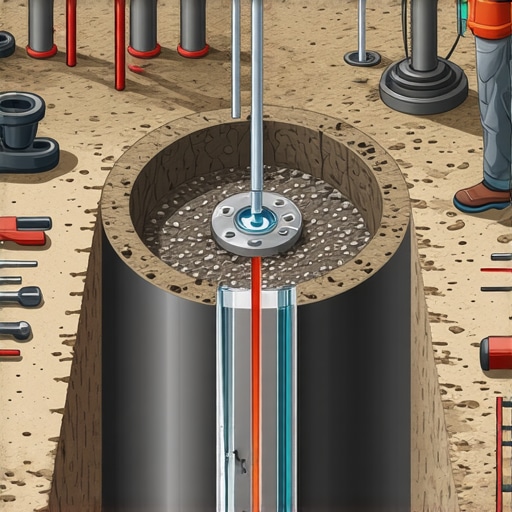
The Gurgle of Failure: When Your Borehole Chokes
You hear it before you see it. It is that strained, high-pitched whine from the pump controller—a mechanical heartbeat skipping because the veins of your water system are clogged with grit. When you crack open the faucet, the water is not clear; it is a milky, abrasive sludge that feels like liquid sandpaper between your fingers. This is the reality of a silted borehole. After thirty years in the mud and the trenches, I have seen boreholes that were supposed to last a lifetime succumb to the slow, grinding death of sediment infiltration in less than five years. It is not just a nuisance; it is a forensic disaster for your plumbing infrastructure.
My old journeyman used to say, ‘Water is lazy, but it’s patient.’ It will find the tiniest pinhole and turn it into a geyser given enough time. In the context of a 2026 borehole, that patience manifests as the relentless migration of fines—microscopic particles of clay and silt—through your gravel pack and into your screen slots. These particles are not just ‘dirt.’ They are sharp-edged minerals that act as a grinding paste, eating through your pump’s impellers and scarring the internal bores of your distribution lines. If you do not address the silt, you are not just losing water pressure; you are losing your entire capital investment in the ground.
“Potable water shall be protected from contamination. Connection to a nonpotable water system shall be through an air gap or a reduced pressure principle backflow prevention assembly.” – IPC Section 602.2
The Physics of the Silt Trap
Why does a borehole silt up? It comes down to hydraulic velocity. When your pump kicks on, it creates a ‘cone of depression’ in the water table. If the pump is oversized or the screen is poorly designed, the velocity of the water entering the pipe is too high. This ‘entry velocity’ picks up the fines that should be stationary. Once those particles are in motion, they do not stop until they hit something—usually your check valve or the fine mesh of a faucet aerator. This is why optimizing borehole strategies is critical before you even drop a pump into the hole. If the ‘rough-in’ of the well is flawed, the ‘top-out’ will never be clean.
Fix 1: The High-Pressure Surge (The ‘Lungs’ Method)
The first line of defense is air surging. We drop a tool down the hole that seals sections of the casing and blast compressed air into the aquifer. This creates a massive ‘burp’ that forces water out of the screen and then sucks it back in. This agitation breaks up the ‘bridge’ of silt that forms around the screen slots. Think of it like clearing a clogged drain with a kinetic ram; you are using the weight of the water column to hammer the sediment back into the formation where it belongs. This is often paired with vacuum excavation to manage the resulting slurry at the surface without turning the site into a swamp.
Fix 2: Chemical Dispersants (Breaking the Bond)
Sometimes the silt is ‘sticky’—clay particles held together by electrostatic charges. No amount of surging will move them. In these cases, we use food-grade polyphosphates. These chemicals act as a ‘dope’ for the soil, neutralizing the charges and allowing the clay to liquefy so it can be pumped out. This is a forensic approach to chemistry; you have to balance the pH of the water or you risk ‘sweating’ the casing with corrosive reactions. You treat the borehole like a living organism, flushing the toxins out until the turbidity drops to zero.
Fix 3: Mechanical Brushing and Hydro-Jetting
If the silt has calcified—a common issue in hard-water regions where minerals act like a glue—you need a physical intervention. We use heavy-duty nylon or wire brushes on a drill string to scrub the interior of the screen. We follow this with hydro-jetting, using specialized nozzles that spray water at 4,000 PSI in a 360-degree pattern. This is not just a cleaning; it is a restoration of the hydraulic conductivity of the well. For complex sites, borehole installation tips often emphasize the need for cleanouts that allow this kind of mechanical access.
Fix 4: Adjusting the Pump Intake (The ‘Sump’ Strategy)
Often, the fix is simpler: stop sucking from the bottom. Silt settles. If your pump is ‘stubbed-out’ too low in the casing, it is literally acting like a vacuum cleaner for the sediment pile. We can often ‘fix’ a silting well by simply raising the pump five to ten feet. This places the intake in the ‘clear zone’ of the water column. While this may slightly reduce your available drawdown, it significantly extends the life of the motor and prevents the impellers from being sandblasted to death.
Fix 5: Daylighting and Liner Integration
When the casing itself is breached—perhaps by a ‘Fernco’ style coupler failing underground or a split in the PVC—you need to see the problem. This is where daylighting comes into play. By using non-destructive excavation to expose the upper casing, we can check for surface water infiltration that might be washing silt down the outside of the pipe. If the main casing is compromised, we might ‘sleeve’ the well with a smaller diameter liner and a fresh gravel pack, effectively building a new well inside the old one.
“Individual water wells shall be grouted to a depth of not less than 20 feet below the ground surface or into an impervious formation.” – UPC Section 601.4
The Forensic Conclusion
A silted borehole is a symptom of a system out of balance with its environment. Whether it is the chemistry of the water eating your screens or the physics of over-pumping drawing in fines, the solution requires more than just a ‘quick flush.’ It requires an understanding of the subsurface mechanics. Respect the biology of the ground and the physics of the flow. Buy the right site services once, or you will cry every time you turn on the tap and see brown. Plumbing isn’t just about pipes; it’s about the integrity of the source. Keep the grit out of the gears, and your 2026 borehole will still be flowing in 2050.