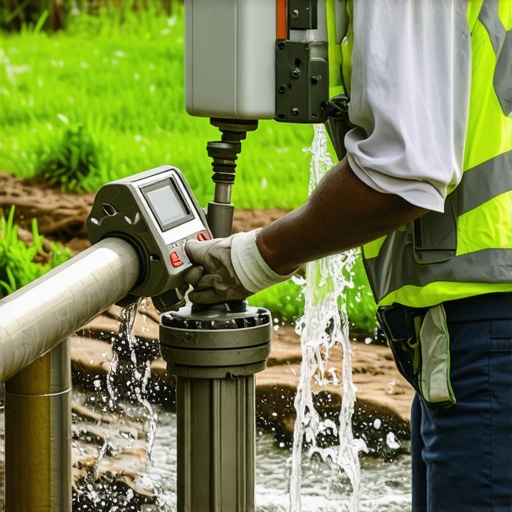
The Physics of a Thirsty Well
My old journeyman used to say, ‘Water is lazy, but it’s patient.’ It will find the tiniest pinhole and turn it into a geyser given enough time. In the world of drilling, this patience works against you. A borehole isn’t just a vertical shaft; it’s a straw stuck into a complex, pressurized geological sponge. When your yield drops, it isn’t magic. It’s physics. Either the aquifer is depleted, the ‘straw’ is clogged with calcified grit, or the mechanical components are fighting a losing battle against friction and scale. After thirty years of pulling pumps and diagnosing dead wells, I can tell you that a ‘dry’ well is often just a ‘choked’ well. We are going to look at how to rehabilitate these systems using modern forensic methods.
“Water-service pipe and fuel gas pipe shall not be installed in the same trench, unless separated by a distance of at least 12 inches.” – IPC Section 603.2
1. Mechanical Surging and Hydro-Fracturing
Over time, the fine silts and clays in the surrounding soil migrate toward your borehole. They pack into the screen like wet concrete, creating a skin that prevents water from entering the casing. This is where we apply mechanical surging. We use a surge block—essentially a heavy-duty plunger—to force water in and out of the screen slots. This ‘breathing’ action breaks up the bridges of sediment. If the geology is stubborn, we move to hydro-fracturing. We seal off sections of the well and inject water at pressures high enough to crack the rock. It’s not just about making a hole; it’s about creating a network of arterial veins that feed the main stack. When we rough-in these systems, we’re looking for those deep fissures that have been dormant for decades.
2. Vacuum Excavation for Intake Header Management
You cannot talk about borehole yield without talking about how you access the infrastructure. If your header lines are buried under four feet of compacted clay, traditional digging is a death sentence for your pipes. I’ve seen backhoes rip through a main line like it was wet paper, turning a simple maintenance job into a $10,000 disaster. This is why vacuum excavation is the only sane way to perform site prep in 2026. By using high-pressure air or water to liquefy the soil and a vacuum to suck it away, we can expose the pipes—a process known as daylighting—without scratching the PEX or copper. This precision allows us to inspect the ‘stub-out’ connections where the borehole meets the main distribution line, ensuring there are no hidden leaks sucking the pressure out of your system. Using vacuum excavation ensures that we don’t disturb the delicate ‘wax ring’ equivalent of well seals or the buried electrical conduits.
3. Chemical Descaling and pH Balancing
If you live in an area with hard water, your borehole is a ticking time bomb of calcium carbonate. I’ve pulled drop pipes that were so encrusted with lime they looked like cave stalactites. This scale doesn’t just sit there; it narrows the diameter of your pipes, increasing friction loss and forcing the pump to work twice as hard for half the water. We use food-grade acids to dissolve this calcification. You’ll hear a fizzing, popping sound as the acid eats the minerals—that’s the sound of your yield coming back. But be careful: if you don’t neutralize the pH afterward, that acidic water will start ‘sweating’ through your brass fittings, leading to dezincification where the metal turns into a pink, brittle sponge that snaps at the first sign of torque. Using optimizing borehole strategies during this phase is crucial for long-term reliability.
“The casing shall be metallic or nonmetallic and shall have a minimum wall thickness sufficient to resist all anticipated physical forces.” – ASTM D1785 – Standard Specification for PVC Pipe
4. Upgrading Site Services and Pump Thermodynamics
Sometimes the water is there, but the pump is a dog. Most residential wells are fitted with pumps that were ‘good enough’ ten years ago. But as the static water level drops in 2026, those old impellers can’t create the lift required. We look at the thermodynamics of the motor. A pump that cycles too often will overheat, causing the wire insulation to become brittle and eventually short out. We recommend installing Variable Frequency Drives (VFDs). Instead of the pump being ‘all on’ or ‘all off,’ the VFD ramps the motor up and down based on demand. It’s the difference between a car idling at a red light and a car redlining every time you touch the gas. When we do a ‘top-out’ on a new installation, a VFD is the first thing I suggest. It protects the ‘cleanout’ zones and ensures the aquifer isn’t being over-pumped, which can lead to a ‘cone of depression’ that sucks air and silt into your fixtures. For complex projects, choosing the right site services can make or break the installation efficiency.
5. Deepening and Precision Borehole Repositioning
When all else fails, you have to go deeper. The water table isn’t a static line; it’s a moving target. If your neighbor puts in a massive irrigation well, your shallow borehole is going to suffer. We use borehole drilling techniques that allow us to extend the depth of an existing shaft without collapsing the original walls. This requires a forensic understanding of the strata layers. We look for the ‘aquiclude’—the hard clay layer that acts as a floor for one aquifer and a ceiling for another. By punching through that ceiling, we can tap into a secondary source that has higher hydrostatic pressure. It’s a messy, loud process that involves ‘dope’ on the threads of every new section of pipe and a constant watch on the ‘stack’ pressure to ensure we don’t hit a pocket of gas. By reducing site disruption during this phase, we keep the property from looking like a battlefield while we hunt for that liquid gold. The key is to integrate these borehole installation tips into your annual maintenance routine before the tap runs dry.
Conclusion: Water Always Wins
You can’t negotiate with geology. If you treat your borehole like a ‘set it and forget it’ appliance, it will fail you. But if you understand the physics of flow—the way a Fernco coupler might fail under high pressure or how a clogged screen acts like a kinked hose—you can stay ahead of the curve. Whether it’s through maximizing safety with advanced site services or simply descaling your lines, keeping your water yield high in 2026 requires a forensic approach. Buy the best equipment once, or cry every time you turn on the shower and get nothing but a wheezing gurgle. Plumbing is a battle; make sure you’re the one with the better strategy. “,