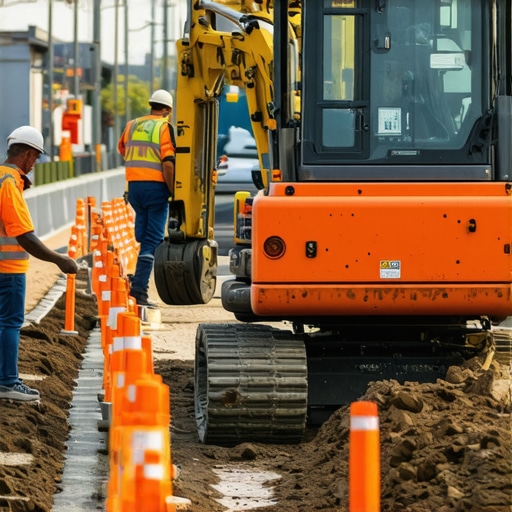
The Anatomy of a Utility Strike: Why the Old Ways are Bleeding Your Budget
I’ve spent thirty years in the trenches, and if there’s one thing I’ve learned, it’s that the earth is a graveyard of forgotten mistakes. My old journeyman used to say, ‘Water is lazy, but it’s patient.’ It will find the tiniest pinhole and turn it into a geyser given enough time. That same logic applies to underground utilities. When a backhoe tooth catches a gas main or a high-voltage line, it isn’t just an ‘accident’—it’s a failure to respect the physics of the subsurface. In the field of high-stakes utility work, the 2026 standards are moving away from the brute force of yellow iron toward the surgical precision of air and water. We are talking about vacuum excavation, a process that doesn’t just dig; it performs a forensic reveal of what’s actually down there before you commit to a rough-in that could cost you a million dollars in liquidated damages.
You see, when you’re dealing with the expansive clay soils of the South—think Texas or Florida—the earth behaves like a living thing. It swells, it shifts, and it shears pipes like they’re made of glass. I’ve seen copper service lines inside a concrete slab snapped clean because the ground decided to migrate six inches to the left during a dry spell. When we talk about site services today, we aren’t just talking about a guy with a shovel. We are talking about choosing the right site services for complex excavation projects to prevent these catastrophic failures. If you aren’t using vacuum technology to clear the path, you’re essentially gambling with a deck stacked against you.
“Backfill shall be free from discarded construction material and debris. It shall be placed in thin layers and shall be mechanically compacted.” – IPC Section 307.2
1. Daylighting: The Forensic Reveal of Subsurface Infrastructure
In the plumbing world, we have a cleanout for a reason—you need to see the problem to fix it. In utility projects, that’s what we call daylighting. It’s the act of exposing a utility line to the light of day using non-destructive vacuum power. Imagine a high-pressure water jet—not the kind you use to wash your truck, but a focused stream that atomizes the soil. As that soil turns into a slurry, a high-CFM suction hose yanks it out of the hole, leaving the pipe perfectly intact. I’ve stood over holes where a Fernco coupling was buried for forty years, held together by nothing but luck and rusted clamps. A backhoe would have ripped that connection into a thousand pieces. Vacuum excavation lets you see the corrosion, the dope failing on the threads, and the calcification before the disaster happens. This level of exploring daylighting benefits for sustainable urban infrastructure is the only way to ensure your 2026 project stays in the black.
2. Borehole Reliability and Slurry Management
When we’re doing a top-out on a massive commercial site, the borehole is our lifeline for new service. But if your drilling fluid isn’t managed or your entry point is compromised by mechanical digging, the hole collapses. Vacuum excavation serves as the ultimate support system here. It sucks up the excess slurry, keeping the site from turning into a swamp of grey muck that smells like wet concrete and ancient rot. By optimizing borehole strategies to enhance service reliability, you ensure that the line stays true and the structural integrity of the surrounding soil remains undisturbed. I’ve seen ‘handymen’ try to clear a borehole with a garden hose and a prayer; it ends with a sinkhole and a phone call to someone like me to fix the mess.
3. Precision Potholing in Saturated Clay
Let’s talk about the ‘Slab Leak’ logic. In the South, hydrostatic pressure is a beast. If you dig a hole with a bucket, you’re creating a localized depression where water will pool, softening the soil and potentially causing the very pipe you’re trying to save to sag and break. Vacuum excavation is different. It creates a vertical, precise ‘pothole’ with zero collateral damage to the soil structure. This is critical when you are looking for a stub-out that was buried twenty years ago and isn’t on the original blueprints. You need vacuum excavation for accurate subsurface assessments because it allows you to feel the change in resistance. You aren’t just blindly stabbing at the earth; you are peeling back the layers of the geological onion.
“Horizontal drainage piping shall be installed in practical alignment and at a uniform slope.” – IPC Section 704.1
4. Integrating Site Services for Urban Density
The cities are getting tighter. The stack of utilities under a downtown sidewalk is a nightmare of fiber, gas, water, and sewer. There’s no room for error. If you nick a fiber line while trying to replace a sewer lateral, the downtime alone will ruin your reputation. This is where how site services drive efficiency in urban construction becomes the difference between a successful job and a lawsuit. We use vacuum trucks to weave between the existing lines, like a surgeon working around an artery. You can’t ‘sweat’ a joint on a gas main, and you certainly can’t un-cut a fiber optic cable. The vacuum is the only tool that respects the density of the 2026 urban environment. It’s about more than just moving dirt; it’s about managing the risk of the unknown. When you see that black sludge of an old grease clog during a cleanout, you know exactly what you’re up against. When you see a high-pressure gas line through a vacuum-dug pothole, you have the same clarity.
At the end of the day, the earth doesn’t care about your schedule. It only cares about gravity and pressure. If you try to fight those forces with a dull bucket and a distracted operator, you’re going to lose. Vacuum excavation is the industry’s way of finally admitting that the old ways were dangerous. It’s about maximizing safety with advanced site services in excavation. Don’t be the guy who thinks a wax ring is the solution for a foundation-level leak. Use the right tech, respect the physics of the ground, and for the love of all things holy, stop digging blind. Water is lazy, and it’s waiting for you to make a mistake. Don’t give it the satisfaction.
Reading this post really highlights the importance of integrating vacuum excavation early in the planning stages of utility projects. The analogy about water being patient really resonated with me; underground utilities often fail silently until it’s too late, and traditional digging methods only increase the risk of costly damages. I’ve personally seen a project where vacuum excavation uncovered an outdated sewer line that wasn’t on the blueprints, preventing a potential disaster. It makes me wonder, though—what are some of the biggest challenges contractors face when transitioning from conventional methods to these precise, water- and air-based techniques? Also, how accessible is this technology for smaller projects or in areas with limited resources? I believe widespread adoption could save not just money but also lives, especially in densely built urban environments.